Teagan's Blog

When words fail, music speaks <3

Music Growth/ Free Inquiry Final Reflection

The question I chose to explore for the term:

How can I, as an already skilled ukulele player, transfer some knowledge of note reading, music theory, and basic songs to the guitar?

My end of term goals:

Learn at least 3 simple songs with 3 or 4 chords that I can sing and play. As the term goes on I hope to take on pieces of increasing difficulty. Maybe even trying to do some songs with both piccing and strumming. I hope to reach a confidence level where I would feel comfortable performing these pieces in front of an audience/ recording myself on GarageBand.

I feel that I have met this goal. Since the midterm period, I have learned, practiced, recorded and played a bunch of songs on the guitar. This includes:

  • Don’t Worry Be Happy
  • Edelweiss
  • Love Story
  • Here Comes the Sun
  • For my final submission, Here Comes the Sun, I was able to incorporate both picking and strumming, record it on GarageBand, and then edit it on IMovie. This is something that I feel very proud of. I also feel like it demonstrates my full capability on guitar at this point in time.

My Music Growth Plan (for reference): https://docs.google.com/document/d/1liBW5zRAgTxgbFCiLuMRGhEHp4hLvfntsdH52QrzdTY/edit?usp=sharing

Throughout the term, I have scaffolded the tasks I set out for myself. I started by learning about the guitar as an instrument (where it came from, names of the open strings). Then, I learned how to play some simple scales, explored picking some songs (like Happy Birthday), and some chords. After I felt confident in this, I proceeded to learn some songs. As the term went on, I took on more challenging pieces.

Overall, I am very proud of how far I have grown as a musician. Learning guitar has been something that I have wanted to do for a very long time, but never got around to. Having a better, and more generalized understanding of music and musical instruments can help me, as a teacher, to integrate music into my classroom. As well, there may be some opportunities for playing guitar both in, and out of a school environment.

As I move forward into next term, I will definitely continue to play and practice guitar. This experience was very enjoyable for me, and it is something that I hope to continue. I think that I will try to still work on being more “musical” in my playing, rather than just playing the notes/ chords.
Week 11 Reflection- Choose your own Adventure

This week in EDCI 336, we had the chance to chose something that interested us, and explore it. I chose to explore the app, Audacity. This is something that I was not familiar with prior to this experience. As a child, I was always the type to make cringe videos and edit them. In high school, I told part in Media Arts classes, and Film and Television classes in which had a large focus on editing. Up to this point I have used various editing tools but my favourites are GarageBand for audio, and IMovie and Final Cut Pro for audio/video mix. For those of you who are not familiar with Final Cut Pro, it is very similar to IMovie but has a bunch more “paid” features that can take your videos to the next level. Unfortunately, I do not have access to this program anymore, so I use IMovie (which still works amazing by the way).

At first, Audacity seemed very confusing to me! The set-up was very different than other apps that I was used to. So, I went searching for a tutorial.

After watching this video it was much easier to understand the app. I proceeded to go and create my own “Marine Land” advertisement song. Although I will not be playing this for you because it is very embarrassing, I was able to edit the pitch, playback speed, and equalize and normalize the sound. It still does not sound amazing, and I definitely have some editing to still do, but it is a start!

I really like the specific tools like noise removal, and equalization. These are really helpful tools that I do not have access to on the editing apps I use at the moment. However, there are A LOT of features on the app, and it can be confusing for a beginner, like myself. Overall, it is fairly similar to FinalCut Pro, but it is free! I think with a bit more playing around, and practice, this app could definitely be a helpful tool for me to use both in the classroom, and in my personal life.

Featured Image by Cedrik Wesche on Unsplash

Song- Here Comes the Sun Final!

This song ended up being a LOT of work taking into account both playing and editing! I ended up having to play and record different sections of the song separately. This is because it was almost impossible for me to successfully play the song through without mistakes. However, by piecing small chunks together, I made it sound like one take….. (thank you high school film editing class….). I recorded this on GarageBand. I think there were about 5 audio tracks that I edited and spliced together.

Then, I exported this file to IMovie when I was happy with it. From there, I filmed myself playing the song while listening to the track I had just made. I added this as a track to IMovie, cut the sound from the video, and aligned it to my sound recording. This took a bit of effort! HAHA! Finally, I edited this together and added an introduction slide, title, and image.

FYI: Since the video and audio were not taken at the same time, the video might not be perfectly aligned with the music track (but I promise everything you see and hear is me:))

Here Comes the Sun Cover- Teagan Hunt

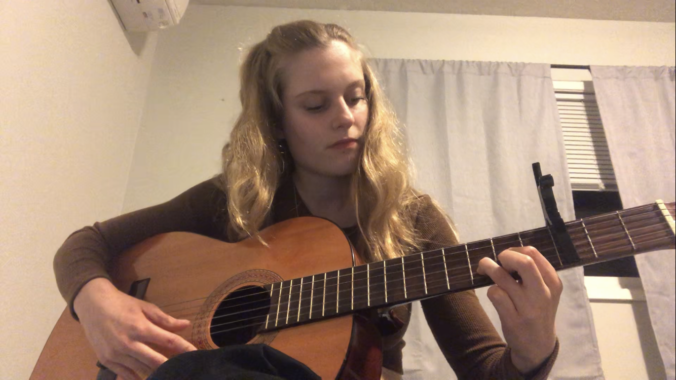
I played the song with a capo in the third fret. I chose to play it here because it suited by voice best. Ultimate Guitar website suggested that I play it in the fifth fret, but that was too high (or low) for my voice. I think the third fret worked really well. I did not play this song with a metronome. I did try at first; however, I found it really difficult because I ended up playing some of the more difficult sections slower. This song features numerous of my “challenge chords” like F, C, and E7. It also includes several picking sections. I posted a break down of these “challenge sections” in a blog post last week. Like I mentioned before, I adapted this song from various resources (Ultimate Guitar, ukulele sheet music, etc. ) and make it my own. Overall, I am very happy with my results.

Education Technology Final Project

For our Education Technology Group Inquiry Project we chose to focus on technological games. Our question was:

How can the use of technology through games impact student learning?

We each individually focused on a game or two that were either familiar with, or wanted to explore. Below is the list of who in our group focused on what:

Wordle/Set- Talia Sutherland

Prodigy- Teagan Hunt

Kahoot- Amanda Beechey

Jeapordy- Paige Hart

At the end of our individual inquiries we connected and brainstormed some “general findings” that seemed to relate for all of our resources. We also answered some of the inquiry questions provided in the assignment outline. Finally, we came together and recorded our presentation using the chrome extension, Screencastify.

Ultimately, this inquiry gave us the opportunity to learn about technological games and how they can be implemented into the classroom.

EdTech Presentation- Talia, Teagan, Amanda, Paige

“Bits” for Here Comes the Sun- Part 1

This week I started working on some of the parts of “Here Comes the Sun” by The Beatles. This song has lots of various different components from picking to strumming and singing. For this reason, I have split up the “doing” of the song over two weeks.

This video features 3 of the tricky sections that are featured in Here Comes the Sun:

  1. The chorus? This part uses quick chord changes, and uses some picking as well. I figured out the picking part by ear.
  2. The bridge picking part. This picking piece gets played right after the verse and before the chorus. I also figured this out by ear.
  3. The intro picking. This gets played at the beginning of the song before anything else. I learned this from one of the guitar tabs featured on https://tabs.ultimate-guitar.com/tab/the-beatles/here-comes-the-sun-chords-1726934

As you can see, I like to figure out new things, and adapt, so that it works for me. I always like to play around with different picking and strumming patterns and find something I like. My old ukulele teacher would call this “noodling” (since I would always do it when she was talking….haha oops). Most of the strumming patterns and chords I am getting from Ultimate Guitar, while most the picking I have just figured out. I am also not utilizing everything on Ultimate Guitar. Since I am still very beginner, I am changing the arrangement and making it fit for me and my needs. I also have ukulele sheet music for Here Comes the Sun. This has also been of value to me.

I am a bit concerned that this song is too difficult for me at the moment; however, I will make it work. For the final product, I might have to record different pieces of the song separately, and then edit it together. This would allow me to play several “imperfect” takes, but still use pieces of them. This is a song that I really enjoy listening to, singing, and playing, so I look forward to embracing the challenge in the last remaining weeks.

Featured Image by Pablo Heimplatz on Unsplash

Week 10 Reflection: Gamification and Game-based Learning

Today, we had a guest presenter come and talk to us about Gamification and Game-based learning. This is something that I look back on from my elementary, middle, and high school years, as a positive experience. I remember having extremely fond memories from going to the computer lab in elementary school. I remember engaging with in a wide-variety of typing games (All the Right Type, Dance Mat Typing, Tux Typing), Incredibox, Club Penguin, Early Learning House Game (Millie’s Math House, etc), Poptropica, Math Playground, Prodigy, and many others that I cannot remember the name of! I welcome any memories of computer games from elementary school in the comments. Looking to dwell in the nostalgia:) For me, I think that typing is such a crucial skill for students to learn at an early age. This was something that I learned in Elementary school and has been super helpful to me in school. It has been awhile since I have been in an elementary school classroom, so I am unsure if typing is still emphasized as highly as it was when I was in school. I hope it is!

I think Tina’s presentation was really interesting. Although her scenario is specific to high school education, I still think there are many things I can take away from it. Specifically, her organization and personalized learning on Google Classroom. Throughout my middle and high school years, I had a lot of experiences with Google Classroom, and can say that this may have been the best I have ever seen. I am also grateful for all the technological resources that Tina introduced us to. Almost all of these resources were new to me, and something I hopefully have the opportunity to explore in the future.

When browsing games on Hour of Code with Amanda, we chose to play AI for Oceans. We chose this game because it looked both simple and fun. We are both hoping to have the opportunity to work with younger students in our practicums, so this game seemed appropriate. This game was not really your typical coding game; rather, it focused on much simpler objectives. Your goal was the program the AI machine so that it cleans the ocean properly. You would then go through and click which things belong/ don’t belong in the ocean. This would basically “code” the machine. https://hourofcode.com/ai-oceans

How do we embed authentically and with care?

This is a topic that we have focused quite a bit on this term. Specifically, our most recent assignment in EDCI 306 is about embedding EDI principles into our classroom practices (due on Friday btw). The five R’s however, were something new to me. In connection to The First People’s Principles of Learning, the 5 R’s, respect, relevance, reciprocality, responsibility, and relationships are greatly emphasized. These 5 words appear to foster a foundation for Indigenous knowledge, culture, and education. As future educators, these words are crucial to reinforce throughout all areas of study. Most importantly, it is crucial to acknowledge the importance of these 5 words when teaching Indigenous Education. Ultimately, the reading provided me with some information and interesting considerations.

Featured Image by Kelly Sikkema on Unsplash

Week 9 Reflection-Jeff Hopkins and PSII

Today, Jeff Hopkins graciously came and presented to us via. Zoom from the Pacific School of Innovation and Inquiry (PSII). To summarize, PSII is basically an independent high school where students have the opportunity to learn what they want to learn. All of the student learning is focused around a central inquiry project” that the students will work on for the year. Through this project they will engage with specific learning competencies and a variety of subject areas like math and language arts. At PSII there are no real “classes” and rather just differentiated spaces around the school where students can learn such as large collaboration spaces, or a quiet space. Ultimately, PSII hopes to put meaning behind student learning.

I thought the concept of PSII was SUPER cool! It was something I had never heard about before, which was surprising considering I have lived in Victoria my whole life. Something that really stood out to me about PSII was the opportunity for personalized student learning. It is evident that students learn best when they are learning about something they are interested in, and Pacific School of Innovation and Inquiry gives students just that. I also appreciated how students were being assessed. There is no real tests or exams, and rather educators would report on personal inquiry progress as well as the learning competencies set out by the school. Therefore, it appears that both formative and summative assessment styles are being used, but just in a different way.

I think the idea of PSII can connect back to the movie we watched at the start of term. Both schools followed a somewhat “alternative” model, and were driven by student interest. Ultimately, I believe that these schools are the way of the future. Even now, we can see schools shifting away from standardized testing and marking, and adopting proficiency scales. This further emphasizes how the curriculum is constantly changing and evolving. However, my only concern is that students will struggle when they transition to the college/university setting. How will they apply and get into university with no marks for each subject? How will they adapt back to a standard model of learning?

Featured Image by Ismail Salad Osman Hajji dirir on Unsplash

Song- Love Story

This week I channelled my inner Taylor Swift and tackled her classic, “Love Story”;) This is a song that I really like listening to, and thought it would be interesting to learn on guitar. This is also the first song that I have learned to play that I did not already know how to play on ukulele (if that makes sense). The chords were definitely more of a challenge, and took quite a bit of practice (you can hear that the chords and chord changes sound a bit more sloppy:/). It also includes a F chord, a tricky chord that I have been working on for the last couple weeks. I played along to this song with a metronome of 110. I think this was an appropriate tempo for this song. I also opted to skip the key change at the end of the songs because I do not know a Bm chord yet:/

Love Story Cover (Teagan Hunt)

This week I also learned and practiced a mash-up that I arranged a while back. It is a mix of the two songs, “Hey Soul Sister” by Train and “I’m Yours” by Jason Mraz. These two songs follow the same chord progression so it was super easy to tie the two together. Over the last week when I played around with this song I used a C, G, Am, F chord progression. Normally when I play this song on ukulele I use a D, A, Bm, G chord progression; however, I am still working on my Bm chord on guitar:). For this reason, I played the song on guitar with a capo on the second fret so that the song was in the same key as I am used to playing it. Unfortunately, I did not record this song.

Looking back at some of my guitar progress so far, I can definitely notice improvement. It is evident that my chords and abilities on the guitar are much better than a few weeks ago. I have also made sure to chose songs of increasing difficulty each week which has helped to keep me challenged and engaged with what I am learning.

In the final 2 weeks of my music growth, I would like to learn how to play Here Comes the Sun by the Beatles. This song incorporates both picking and strumming. It will definitely be a challenge and test my guitar skills, but I look forward to trying my best!

Week 8 Reflection- Should a disability define a person?

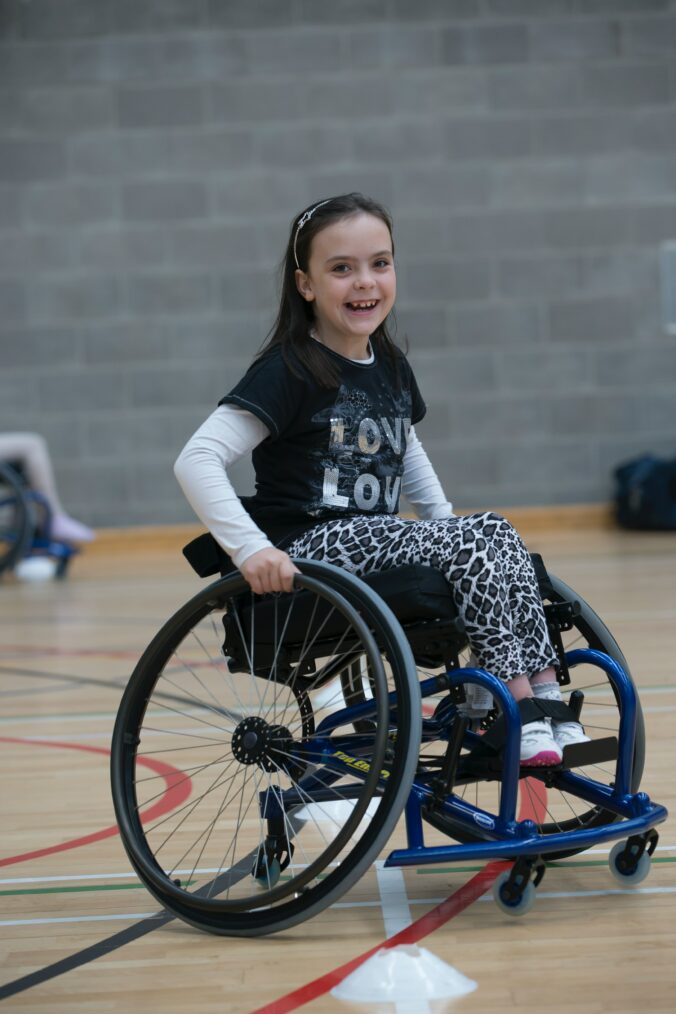
Something that stood out to me from today’s presentation on technology and inclusion by Tracy Humphreys was personal identity and how this relates to individuals with disabilities. We started off our session today with a discussion about our personal identities. At first, I really struggled to come up with ideas for this topic. However, with the help of my peers I started to discover that this was a VERY broad topic, and there are so many emotional and physical traits that make me the person I am today. I connected this idea of personal identity to persons with disabilities. My mom has always emphasized to me that I should not let a disability label a person. For example, rather than saying “an autistic child” you would say “a child with autism.” This concept of personal identity and disabilities peaked my interest and inspired me to explore externally and internally explore further.

After exploring my personal identities, I have chosen to split it into 3 categories: values, interests/talents, personality. 

Values:

  • Relationships 
  • Honesty
  • Respect

Hobbies:

  • Being active
  • Music

Personality (physical and emotional):

  • Female
  • Outgoing
  • Hard-working
  • Anxiety

Personally, I am of mixed minds on whether or not to add anxiety to that list. On one hand, I do feel like it impacts my everyday life, and that I carry with me as a person. I also feel that weaknesses ARE something that define you, and are important to recognize when exploring a personal identity. On the other hand, I really do not like the idea of labeling myself based on this. National Network discusses some of the standards for referring to persons with disabilities. They explain that it is important to emphasize the abilities and strengths of a student rather than their limitations and weaknesses. They also mention that avoiding phrasing like “normal” is important. 

Ultimately, as a future teacher, I think it is important to recognize that many students have varying disabilities, but they also have lots of strengths. Not labeling students based on their disability allows you to be respectful of their situation, and obtain a professional position. Disabilities can be a sensitive topic for the students and their parents so it is crucial to talk about this in a neutral manner. 

I a very curious to hear your perspective on this question. Do you think disabilities are part of one’s personal identity? Should it be used to label a student?

Source: https://adata.org/factsheet/ADANN-writing

Featured Image by Danny Nee on Unsplash

Song- Edelweiss

Edelweiss- Sound of Music (performed by Teagan)

This week I chose to practice and perform Edelweiss. This has always been a song that I thought was so beautiful. Although it is a slow, ballad type song, it contains much quicker chord changes (as you can see my fingers are moving around super quickly). I played this song with a capo on the first fret. This allowed the song to be in the original key it was performed in. I did NOT play with a metronome this week for two reasons. First of all, it is a fairly short song and I feel like depending on how you want the song to feel, you can speed up and slow down at specific parts. Second of all, sometimes the metronome syncs me out. As soon as I hear the annoying clicking in my ear I get a little bit paranoid that I will be overtime and I become overly cautious about my speed (which can make my playing and singing more sloppy). I will hopefully use it again next week though:)

I think this piece was a bit more of a challenge for me (although still not too difficult). The other two pieces I have played for you so far I basically sight read and sang through (meaning it basically was a one-take situation). This song took a couple more tries to nail down. Personally, I think that my previous music abilities have allowed me to pick up chords and chord changes pretty easy. The only thing that I have found to be a little bit challenging so far is the F chord:/ Next week, I hope to incorporate and play a song that uses an F chord. This will give me a bit more practice with this chord so that I can use it smoothly in songs.

Here is the ultimate guitar chords I used: https://tabs.ultimate-guitar.com/tab/misc-musicals/the-sound-of-music-edelweiss-chords-2091795

Featured Image by Bruno on Unsplash

« Older posts

© 2026 Teagan's Blog

Theme by Anders NorenUp ↑